At That’s the Rub in Bloomington, Indiana, a customized massage starts with what your body needs today. Sometimes, that conversation begins with four familiar words.
I once had a bi-weekly massage client who would come in and say, “Let’s do the usual.”
After a couple of sessions, I started wondering what exactly “the usual” meant to her.
One thing you may not know about massage therapists is that we want you to like our massage as much as we enjoy giving it. And as a recovering people pleaser, I had begun internalizing those four little words.
Was she expecting the same massage every time?
Because I’m not very good at that.
Eventually, I got out of my own way and asked.
“What does ‘the usual’ mean to you?”
Her answer was essentially: You know—the great, focused massage you always do.
Whew.
She didn’t mean repeating the same sequence. She meant figuring out what she needed that day, focusing our session on those needs, and checking in to make sure what I was doing was working for her.
Your body has been living an entire life since your last appointment. You may have been working out differently, traveling, gardening, sitting more, sleeping differently, feeling stressed, feeling strong or simply living your everyday life.
You bring that information into the room with you.
We bring our training, anatomy knowledge, curiosity, critical thinking and massage nerdiness.
Together, we figure out what makes sense for you today.
A customized massage isn’t simply spending more time wherever you say it hurts. It’s paying attention to what’s present, asking questions, noticing how your body responds and adjusting as we go.
The care continues after your massage
Sometimes what we notice gives you something useful to explore afterward—an exercise, a different way to move, breathwork, meditation or another practice that supports what we’re doing together.
Because as valuable as massage is, what you do during all the hours you’re not on the table matters enormously.
The more attention you give your body between appointments, the more information we have when you return.
Care. Attention. Noticing. More care.
Every body deserves that.
Creating a little more space to care for yourself
As we move toward the holidays, we have a couple of opportunities at That’s the Rub to stay connected to yourself during a season that can easily become about rushing from one thing to the next.
Beginning Saturday, November 21 through December 19, from 2–3:30 PM, I’m bringing back Stretch & Relax.
I’ve missed this: relaxing music, bolsters, a yoga mat—and you.
We’ll spend 90 minutes with guided stretching, breathwork and mindfulness, with a little massage incorporated into some positions for those who want it.
Not another thing to accomplish.
Just time to be with your body and pay attention.
We’ll also be offering Sound Bath with Joy, with dates and times coming soon.
You can join the waitlist for Stretch & Relax and Sound Bath with Joy now. When registration opens, the people on the list will be the first to know.
Because maybe one of the nicest things we can give ourselves during the rush of the season is permission not to rush through it.
And the next time your massage therapist asks what you’d like to work on?
You don’t necessarily need to know.
You can even say, “Let’s do the usual.”
Just make sure the two of you know what “the usual” means. Grin.
When you book a massage, it can be easy to think you're buying 60 or 90 minutes of someone's time.
And technically, you are.
But that's not really all you're paying for.
You're paying for the experience behind the hands
You're paying for the years it took that therapist to learn how to listen with their hands.
You're paying for anatomy and physiology, continuing education, daily practice, years of experience, and the thousands of bodies that have taught them that no two people arrive at the table the same way.
At That's the Rub in Bloomington, Indiana, we've never wanted massage to be something we simply perform on you.
We pay attention. And you, the client, help create the experience.
Your massage is a partnership
You don't just lie there while we do something to you. You're a partner in your massage—what you want to receive, what you're experiencing, and how your body responds all help guide the session.
How are you moving today? What's changed since the last time we saw you? Where does your body seem to be asking for more space, more movement, or simply a little less demand? What patterns in your everyday life might be contributing to what you're experiencing?
Sometimes that means the massage we planned isn't exactly the massage you need.
Good.
Because you aren't a protocol.
You're a person. Everything we do is customized to fit YOU.
Your needs aren't the same as the last person on our table. Responding to that requires critical thinking, the ability to adapt what we're doing in an instant, and the willingness not to hold onto a routine simply because that's what we learned.
We invest in education—and in our therapists
That philosophy affects how we've built our business, too.
At That's the Rub, we invest in education.
Lisa is a board-certified continuing education instructor who teaches our therapists bodywork modalities, critical thinking skills, treatment planning, and the business of massage. We share what we've learned through experience while giving each therapist room to develop experiences and perspectives of their own.
We encourage our therapists to keep learning—from one another and from educators and resources outside That's the Rub. Because when one therapist becomes better at what they do, all of us benefit. A rising tide lifts all boats.
We provide a safe space, equipment, linens, products, scheduling, support, and all the other decidedly unglamorous things that allow a therapist to concentrate on the person in front of them.
What are you paying for when you get a massage?
Could massage be offered differently?
Of course.
There will always be less expensive options, just as there will always be more expensive ones. Price alone doesn't tell you whether something is right for you.
But it can be helpful to know what you're paying for.
When you come to That's the Rub, you're not paying for someone to spend an hour going through the motions or simply doing something to you or for you.
We become partners with you in caring for your body and creating the massage experience you want.
You're paying for attention. Awareness. Knowledge. Compassion.
You're paying for the experience to recognize situations that may seem unusual to you but that we've encountered many times—and for a therapist willing to share their perspective while remaining curious about yours.
You're paying for a therapist who can notice what is happening beneath their hands and change course when your body gives them new information.
And you're paying for a business that believes the people doing this work should be supported in becoming better at it.
We've believed since we opened our doors that massage is more than an hour on a table.
It's a relationship with your body. It's a relationship with your massage therapist. It's a relationship with your health.
A lot of people who come into That's the Rub in Bloomington don't realize inflammation is part of what they're feeling. They describe stiffness that won't release, tension that returns no matter how much they stretch or rest, swelling or tenderness that hangs around longer than it should. They've been pushing through it for weeks or months, and the body has been adapting around it the whole time. By the time it ends up on our table, the original problem has usually grown a second one: the compensation patterns the body built to protect itself.
That's the part therapeutic massage can help with.
What inflammation does when it lingers
Inflammation is part of the body's natural healing response. It's how tissue calls in repair after overuse, strain, injury, surgery, or sudden stress. The problem isn't inflammation itself — it's inflammation that doesn't resolve.
When the response lingers, the body starts adapting around it. Movement changes, muscles compensate, posture shifts, connective tissue tightens. Areas become guarded, tight, sensitive, or exhausted from carrying stress they were never meant to hold long-term. You can function, and most people do, but the body stops feeling like itself.
How therapeutic massage helps
Therapeutic massage often gets grouped in with relaxation or self-care, but the work changes substantially when the goal is recovery. A results-oriented approach starts with what the tissue is responding to, where the body is compensating, what systems may be overloaded, and what kind of pressure and pacing will actually help the body let go rather than guard against the work.
Inflammation responds differently depending on how long it's been present, how reactive the tissue is, and what the body is trying to protect. Because of that, treatment is not one-size-fits-all. Sometimes deeper pressure helps, and sometimes the body needs gentler work first. The goal isn't to force change into the tissue, it's to help the body move toward better function, circulation, mobility, and recovery without overwhelming an already stressed system.
Here's something I see often in my chair: you want a deep tissue massage, but it doesn't feel deep enough. That's a conversation to have with your therapist. Is there a tissue reason they aren't going deeper? Often when the body is already under stress and you ask for deeper pressure, the muscle stiffens and won't let the therapist work deeper — it guards its tension because it's protecting something. That's a deeper conversation about what's going on with the tissues, and a change in the treatment plan before moving forward to deeper pressure. It helps with the client's expectations of deeper work and the therapist's read on working too deep for what the tissues actually need.
Have you ever been sore after a massage? It may have been too deep for what your body needed that day. My professional suggestion: ask your therapist. It's your massage. You're allowed to ask for things you like or don't like. But asking for deeper pressure when your therapist doesn't recommend it isn't the answer for getting better results, it's the answer for unnecessary pain or discomfort after your massage. Massage doesn't have to hurt to be functional.
Acute and chronic inflammation respond differently
New inflammation and long-standing inflammation behave differently, and they call for different work.
Acute inflammation is the early-stage response — swelling, warmth, tenderness, reduced range of motion, and pressure sensitivity after an overuse incident, a strain, an injury, surgery, or sudden physical stress. During this stage lighter techniques are usually more appropriate, and gentle therapeutic work along with lymphatic-focused techniques can encourage fluid movement and reduce the feeling of pressure and congestion without increasing irritation. A lot of the relief here comes simply from the body no longer feeling stuck holding excess fluid and guarding patterns.
Chronic inflammation is what shows up when the response never fully resolved. The body adapts around the discomfort: posture shifts, movement patterns compensate, connective tissue tightens, and certain muscles start overworking for others. This is when clients say some version of, "I always feel tight," or "I can function, but I don't feel normal." As the tissue becomes less reactive, deeper therapeutic techniques can gradually be introduced to address the tension patterns and restrictions that have built up over time.
The lymphatic piece most people miss
One of the biggest pieces people overlook with inflammation is the lymphatic system. When inflammation is present, fluid and inflammatory byproducts can accumulate in the tissues. That buildup contributes to swelling, heaviness, stiffness, pressure sensitivity, and the sluggish recovery that makes people feel like they can't shake what they're dealing with.
Lymphatic drainage massage is gentle, rhythmic work that follows the body's natural drainage pathways. It doesn't look or feel like deep work — many people are surprised by how light the pressure is — but it's often exactly what an overloaded system can receive most effectively. At That's the Rub, lymphatic drainage is available as a standalone service. It's also a common component of our Advanced Therapeutic Massage, where we combine lymphatic techniques with other modalities in a single session, tailored to the specific tissue and goals you bring in that day.
What to expect on your first visit
If you're coming in for inflammation-related symptoms, expect more conversation than you might at a routine appointment. Your therapist will ask how long symptoms have been present, what makes them better or worse, what activities or medical events preceded them, and what you're hoping to feel different. This is part of why sharing your health history with your therapist matters — without that context, the treatment plan is a guess.
From there, expect the first session to focus on what your tissue can receive today, not on how deep we can go. Progress comes from sessions that build on each other, not from one session that tries to do everything at once.
Why consistency matters more than intensity
One massage can absolutely help someone feel better. When inflammation or injury has been building for weeks, months, or years, though, consistency matters more than intensity. Early in a treatment plan, sessions are often scheduled closer together to break the cycle the body has been stuck in. As symptoms improve and the body holds the work between visits, sessions naturally space further apart.
We adjust treatment plans based on how your body responds, how quickly symptoms return, your activity levels, your stress load, your recovery patterns, and what we see in the tissue from one session to the next. That flexibility is part of a results-oriented approach. We set realistic goals for the treatment, talk through what we recommend you do between sessions, and adjust as your body tells us what it needs.
Our approach at That's the Rub
Effective massage therapy is not about using the deepest pressure possible. It's about understanding what the body needs in the moment and building treatment that supports real change — focused therapeutic work, lymphatic support, mobility work, nervous system downregulation, addressing compensatory patterns, helping the body recover from chronic overload, in whatever combination the day calls for.
The goal is always the same: helping you move better, recover better, and feel more at home in your body.
May this help you make the best choice for you when you book your next massage in Bloomington.
That's the Rub,
Lisa
This article is educational and reflects clinical observation, not medical advice. If you have persistent inflammation or a recent injury, please consult your physician.
Frequently Asked Questions
Can massage reduce inflammation?
Therapeutic massage can help the body process inflammation by supporting circulation, encouraging lymphatic flow, and reducing the protective tension patterns that build up around an inflamed area. It doesn't replace medical treatment for the underlying cause, but it can meaningfully change how the body feels and functions while it heals.
Is deep tissue massage good for chronic inflammation?
Not always, and not first. When tissue is reactive or guarded, asking for deeper pressure often makes the body protect more, not less. Most chronic inflammation cases respond better to a graduated approach — lighter, lymphatic-focused work first, then progressively deeper techniques as the tissue allows. Your therapist reads what's happening in the tissue and adjusts from there.
How often should I get a massage if I have chronic inflammation?
Early in a treatment plan, sessions scheduled closer together — often weekly or every other week — help break the body out of the same inflammatory cycle. As symptoms improve and the body holds the work between sessions, the spacing naturally extends. The right cadence is the one your body tells us it needs.
What's the difference between lymphatic drainage and regular massage?
Lymphatic drainage is gentle, rhythmic, and works with the body's natural fluid pathways rather than into the muscle. It doesn't feel like deep tissue work, and that surprises people — but for swelling, post-surgical recovery, sluggish recovery, or highly reactive tissue, it's often the most effective starting point. At That's the Rub, you can book it as a standalone session or as part of an Advanced Therapeutic Massage.
Unlike your doctor, your massage therapist spends a whole hour with you — massaging your tissues, moving fluids around, and helping the body get rid of things that have settled and been there for a long time. Sometimes too long. The body's job is to maintain homeostasis no matter what, and it will do that at the detriment of something it might feel isn't necessary for life. For instance, a leg.
That's the part most people don't realize: an hour of skilled hands on tissue is a clinical event, and it intersects with whatever else is happening in your body whether we know about it or not.
So here's the simple ask: tell us what's going on.
What we can't see
What I've seen recently is a big uptick in people not sharing their medical information, and with massage there are too many unknowns. We are massage practitioners, not MRI or X-Ray machines. We can't see inside the body. We take the medical information you tell us and build a massage plan that aligns with your goals for the treatment, while also making the changes needed to customize the work to your medical situation.
Sharing your information doesn't mean you won't get your massage. It just means we're not putting you at more risk than we do good once you're on the table relaxing.
What can go wrong when we don't know
Here's a real example. If you're prone to thrombosis — a clotting issue usually established in the legs — but you don't share that information with your massage therapist, they may work deeper on your legs than what would otherwise be advised. Their massage could inadvertently cause the body to release a blood clot into the bloodstream, leading to a possible heart attack or stroke.
That's the worst end of the risk spectrum, and most cases are nowhere near that severe. But the principle holds for almost every condition: information we don't have is information we can't account for. Disclosure of all medical conditions is what lets the therapist ensure client safety, enhance the outcomes of treatment, and ensure your comfort while on the table. Everything is customizable, including which strokes we use, where we use them, and how deeply.
What changes when we do know
Here at That's the Rub, we're looking to be your partner in health, not just a one-time relaxation massage. The information you share helps us shape recovery from surgery, recovery from a hard workout, and everything in between.
For instance, I have a regular client who gets bimonthly massage. When they had a knee replacement, we skipped a massage or two while they were in initial recovery. When they started back, we didn't pick up where we left off — we shifted techniques specifically to serve their post-surgical recovery. That helped them recover faster, sleep better, restore range of motion sooner, and have more energy than they would have without massage post-op.
Why does that work? Because we tailored the massage to what their body actually needed in that moment, changed our techniques for better recovery outcomes, AND we didn't put them at undue risk because we understood what was going on. Massage helps the body process the byproducts of anesthesia after surgery by increasing blood circulation. It also calms the nervous system after the stress and tension of any medical procedure, helping the body restabilize and return to homeostasis faster. That homeostatic environment is where the body lives its best life.
We'll dig deeper into how the body handles inflammation specifically in a companion piece coming this week.
What's actually worth sharing
The intake form covers the basics, but here's what clients most often forget to mention that we wish they would:
Current medications — especially blood thinners, NSAIDs, muscle relaxers, antidepressants, and anything new in the last 90 days
Recent diagnoses or imaging — even if you don't think it's relevant to massage, your therapist might
Recent surgeries or procedures — including dental work, cosmetic procedures, and anything outpatient
Family history of clotting disorders — particularly DVT, pulmonary embolism, or stroke before age 65
Autoimmune conditions — RA, lupus, MS, fibromyalgia, psoriasis, or anything that affects how your tissue responds
Pregnancy or trying to conceive — first-trimester clients especially
Skin sensitivities or allergies — including allergies to oils, lotions, scents, latex, or nuts (we use almond and other nut-based oils)
Areas of recent injury — even minor ones, even if they're feeling fine that day
High or fluctuating blood pressure — affects how we work the neck and how quickly we transition you from lying to sitting
If you're not sure whether something matters, mention it anyway. The two-minute conversation is always worth more than the wrong assumption.
Your information is confidential
The information you share with us is confidential, just like the information you share with your doctor. It lives on your intake file, gets reviewed by your therapist before each appointment, and isn't shared outside our team. We use it to make better clinical decisions for you, and for nothing else.
What the research shows
The case for sharing this information is more than just safety — when your therapist has the full picture, the work goes further.
The American Massage Therapy Association reports that massage therapy can reduce post-operative pain, stress, and even the need for pain medications. It also supports reducing scar tissue and improving range of motion. A comprehensive meta-analysis of 33 randomized controlled trials, published in Complementary Therapies in Medicine, found that massage therapy significantly reduces post-surgical pain, both short-term and long-term.
Those results require a therapist who knows what they're treating. The clinical work is built on the medical context. Without it, we're guessing.
Before your next appointment
When you choose That's the Rub, we consider the body in its entirety, not just relaxation in the moment. We want to get long-term results and help you with your health care for the long haul. That means sharing more information than you think you might need, so the proper massage techniques get used at the proper time to get you the best results for your goals.
Before your next session, take five minutes to update your intake form with anything new since your last visit. If you have a complex situation or have had a recent procedure, reach out to us first and we'll talk through it before you book.
That's the Rub,
Lisa
This article is educational and reflects clinical observation, not medical advice. If you have a specific medical condition or concern about whether massage is right for you, please consult your physician.
Frequently Asked Questions
Do I really need to tell my massage therapist about my medical conditions?
Yes. Even conditions that seem unrelated to massage can change what techniques are safe or effective for you. Sharing your medical history protects your safety on the table and makes the work more effective.
Is what I tell my massage therapist confidential?
Yes. Your intake information lives on your client file, is reviewed only by your therapist before sessions, and is not shared outside the practice.
Can I still get a massage if I have a serious medical condition?
In most cases, yes — but the type of massage, the depth of pressure, and the areas worked may change based on the condition. Some conditions require physician clearance first, and your therapist can tell you when that's the case.
What happens if I forgot to mention something at intake?
Tell your therapist as soon as you remember, even mid-session. We'd rather pause and adjust than continue treatment that isn't right for you.
Is post-surgery massage safe?
Post-surgical massage can be beneficial for recovery — reducing pain, swelling, scar tissue, and helping restore range of motion — but timing and technique matter. Most surgeons clear patients for massage at specific points in recovery. Always tell your therapist about recent surgery, and bring any physician clearance you've been given.
We’ve all seen the pattern here in Bloomington: February arrives, and the rush for generic, "fluffy" gifts begins. Whether you're a stressed entrepreneur, a busy Indiana University staff member, or a local athlete looking for recovery, you know the usual suspects: chocolates that disappear and flowers that wilt.
This year, break the cycle. Instead of a temporary gesture, give a gift that fundamentally changes how your partner feels.
Why Choose Therapeutic Results Over Pampering?
At That’s the Rub, located in the heart of Downtown Bloomington, we specialize in therapeutic outcomes. While a "spa day" has its place, we believe the greatest gift is physical wellness.
Our sessions are designed for long-term relief:
Chronic Tension Relief: Perfect for those spending long hours at a desk or in the lab.
Athletic Recovery: For the sporty IU students and local runners who need to get back in the game.
Clinical Excellence: Our advanced intake process ensures we understand your specific body goals.
Valentine’s Day Recovery Options
1. Digital Gift Certificates (Instant Delivery)
Perfect for the busy partner. You can purchase these online and have them delivered to an inbox immediately. If you’re strolling through the B-Line or visiting the Downtown Square, pop into our Body Boutique on North College Ave to pick up a physical certificate in person.
Our couples’ sessions are the most requested slots in Monroe County and require precise scheduling to maintain our clinical standards.
Call our Bloomington clinic at 812-333-3393 to secure your time.
Don’t Forget Your Own Recovery
Self-love is critical for staying active in the Bloomington community. While sorting out the perfect gift, ensure your own body is performing at its best. Hit the Big Friendly Booking Button below to get on the books for your next treatment plan.
Bloomington knows the difference between “that felt nice” and “that actually helped.”
For 15 years, That’s the Rub has focused on the second one: treatment-based massage therapy built around real bodies, real patterns, and real goals.
In a recent feature, Lisa Keplinger—National Board Certified (BCTMB) and Indiana Licensed Massage Therapist (LMT)—described the philosophy simply: therapeutic massage is meant to do the body good. Not as a slogan. As a plan.
What “results-oriented” means at That’s the Rub
A results-oriented session isn’t about chasing pain around the table. It’s about connecting dots:
What your body is doing repeatedly (work, training, stress, old injuries, weird sleeping positions)
Where it’s compensating (the “why does this hurt when that is the problem?” effect)
What kind of work supports healing and movement over time
Lisa put it this way in the feature: the goal is tailored treatment plans and consistent care—showing up as a wellness partner, not a one-off appointment.
The Center + The Boutique (and why that matters)
That’s the Rub has two distinct yet equally important sides to what we do. Treatments happen in The Center—that’s where the hands-on work lives, where we assess what’s going on, make smart decisions, and put a plan in motion. Products live in The Boutique—curated tools, supports, and small upgrades that help your body keep the gains you just paid for.
And it’s not “retail for retail’s sake.” The point of both is the same: support what your body needs between sessions, not just during them.
Because the truth is, most of your life happens off the table. It happens at your desk, in your car, under a barbell, on your feet for eight hours, on the couch with your kid asleep on your shoulder, or in that one position you always end up sleeping in even though you swear you won’t. The Center helps change the pattern. The Boutique helps you hold the change—so your next session builds on progress instead of spending half the hour undoing the same old tension.
A quick self-check: when therapeutic massage is the right call
You’re a strong candidate for treatment-based massage if any of these sound familiar:
You feel “tight” in the same places no matter how much you stretch
Your range of motion is shrinking (or you’re guarding movement)
You’re dealing with recurring neck/shoulder/back/hip issues
Stress is showing up physically (jaw, traps, headaches, shallow breathing)
You want a plan—not a roulette wheel
Why Bloomington keeps coming back
The impact of massage doesn’t end when you stand up from the table. It follows you out the door like a quieter nervous system you didn’t know you were carrying around—shoulders sitting lower, breath dropping deeper, jaw unclenching on its own. The feature nails the real-world effect: people leave feeling lighter and more at ease—and that shift doesn’t stay politely contained in your muscles.
It leaks into everything.
You answer emails with less edge. You drive without white-knuckling the steering wheel. You pick your kid up and realize you didn’t brace first. You sleep longer before your brain starts its 3 a.m. meeting. You train better because your body can actually move the way it’s supposed to, not the way it’s been compensating. Your mood stops getting hijacked by a low-grade ache you’ve been calling “normal.”
That’s the sneaky magic of therapeutic bodywork: when the body calms down, the person comes back online.
Book a session (and tell us what you’re trying to change)
If you’re ready for massage therapy that’s built for progress, not just relief, book a session and bring your goal with you—pain reduction, mobility, recovery, or “I don’t even know, I just feel off.”
Bloom is a Bloomington culture and lifestyle magazine distributed widely around town and published bimonthly, which is why we were proud to be included.
FAQ about Therapeutic Massage
What’s the difference between therapeutic massage and relaxation massage?
Therapeutic massage is goal-driven: pain relief, movement, recovery, and pattern change over time. Relaxation massage prioritizes general comfort and stress downshifting (also valuable—just a different aim).
Do I need to know exactly what’s wrong before I book?
No. “Something feels off” is enough to start. A good session can help clarify patterns and next steps.
How often should I come in?
That depends on your goal and how long the issue has been around. Many people get the best results with consistency—especially early—then shift to maintenance.
Is deep tissue always necessary for results?
No. Results come from the right technique applied intelligently—not from maximum pressure. Deep work is a tool, not a personality.
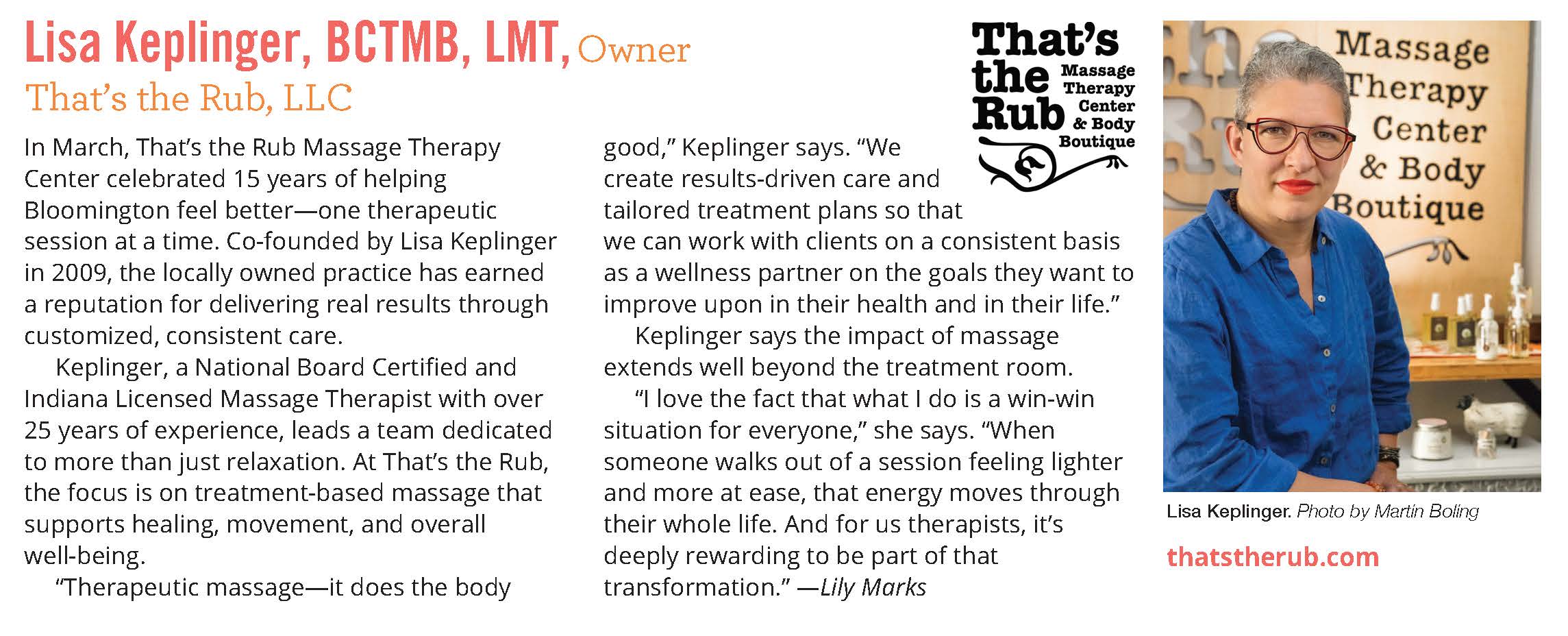
Charlotte R. Licensed Massage Therapist, LMT
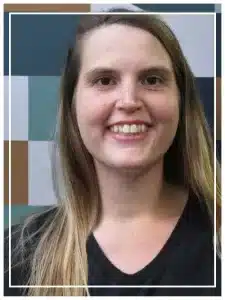
Emily S., Licensed Massage Therapist, LMT
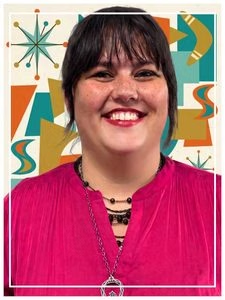
Chris M., Licensed Massage Therapist, LMT
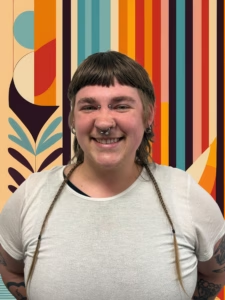
Mike C., Licensed Massage Therapist, LMT
Lisa Keplinger, Licensed Massage Therapist, LMT, NCBTMB