If you’ve been around That’s the Rub for very long, you’ve probably heard us talk about fascia.
And if you’ve worked with me, you’ve definitely heard me talk about it. Grin.
Fascia is connective tissue that creates a continuous network throughout the body. It surrounds and connects muscles, bones, organs and other structures. It helps transfer force, contributes to how we sense movement and position, and plays a role in how we experience what is happening within our bodies.
But what fascinates me most about fascia isn’t simply what it is.
It’s how beautifully adaptable it is.
Your body is constantly responding to the life you’re actually living.
Sit in the same position for hours every day? Your body gets really good at sitting there.
Move through the same handful of patterns? Your body learns those patterns.
Spend weeks clenching your jaw, lifting your shoulders or bracing your glutes because life has been...well, life?
Your body notices that too.
None of this means your body is doing something wrong.
It means your body is doing exactly what bodies do: adapting.
Our bodies are constantly working toward homeostasis—maintaining the internal conditions necessary to keep us functioning while adjusting to everything happening around us.
And maintaining function doesn't necessarily mean maintaining comfort.
Your body may recruit other muscles, change the way you stand or walk, restrict movement or create tension around an area that feels like it needs a little more protection.
Sometimes those adaptations become so familiar that we don't even notice them.
Until the hip hurts.
Or the shoulder doesn't move quite as freely.
Or the neck starts complaining every time you turn your head.
Instead of immediately asking, “What's wrong with me?” I think there's a much more interesting question:
What other options can we give your body?
Massage Can Change the Conversation
Massage is one way we can begin exploring that question.
Touch, pressure and movement provide sensory information to the nervous system while bringing our awareness to areas of the body we may not have been paying much attention to.
Sometimes that creates a really interesting experience.
My hip hurts occasionally. I'll mention it during my intake and tell my therapist where I've been feeling it. Then I get on the table, and they begin working, moving and exploring the area to see what we find.
And sometimes...nothing.
No pain.
No tender spot.
Nothing somewhere else that makes me say, “THERE IT IS!”
The hip that was definitely hurting before the massage simply isn't hurting anymore.
I'd love to tell you that happens every time. It doesn't.
But when it does, I'm reminded of something I tell my clients all the time:
Sometimes the body gets caught up in its own stories and forgets to let go.
That's not meant as a literal scientific explanation. It's the language I use to describe something we see in the treatment room all the time.
Our nervous systems are constantly gathering information and making decisions about movement, tension, comfort and protection. Protection is important. Keeping us alive is, after all, pretty high on the body's priority list.
But sometimes the information changes.
Massage gives us an opportunity to offer different input through touch, pressure, movement, increased circulation and awareness.
Maybe nothing changes.
Maybe something does.
Either way, we're paying attention.
If your body has been getting your attention lately, schedule a massage and give us something to explore together.
And join me in the next article, where we'll take this conversation off the massage table and explore how movement can give your body even more options.
One of the questions we hear most often at That's the Rub is:
"What's the difference between a relaxation massage and a therapeutic massage?"
It's a great question because the answer isn't about which massage is better. It's about what you're hoping to accomplish.
Some people come in because life has been busy, stressful, and demanding. They want an hour where they can finally exhale, quiet their mind, and let their body unwind.
Others come in because their neck won't turn, their shoulder has been bothering them for weeks, or they're tired of the same aches showing up day after day.
Both are good reasons to schedule a massage.
The difference isn't whether one massage is "real" massage and the other isn't. The difference is the goal.
At That's the Rub, we believe every massage should begin with understanding what you want to be different when you leave.
If your goal is to relax, we'll create a session that helps your nervous system settle and gives your body a chance to recharge.
If your goal is to improve movement, reduce discomfort, or address a specific concern, we'll tailor the session to focus on that.
Sometimes those goals even overlap.
The important part isn't choosing the "right" type of massage from a menu. It's having a conversation about what brought you in and what success looks like for you today.
That's why your therapist spends time talking with you before your session begins.
We're not just gathering information.
We're creating a plan.
Everybody is different. What worked for your friend may not be what your body needs today. The best session isn't determined by how much pressure was used or how sore you are afterward. It's determined by whether the session helped move you toward your goal.
Before your next appointment, take a moment to ask yourself one simple question:
"What do I want to be different when I leave?"
Maybe you'd like to turn your head without discomfort.
Maybe you'd like to sleep better.
Maybe you'd simply like to feel lighter than you do right now.
There isn't a wrong answer.
The more we understand what you're hoping to achieve, the better we can partner with you to get there.
Whether you're looking for an hour to unwind or help with something that's been getting in your way, we're here to meet you where you are.
We'll start with a conversation, create a session that's right for you, and work together toward what matters most to your body that day.
Have you ever noticed that the same spot keeps feeling tight, no matter how often you stretch it? That's worth paying attention to. Because "tight" doesn't always mean your body is asking for more stretching. Stretching is one of the best things you can do for your body. It can improve mobility, reduce stiffness, and help you move with greater ease. But occasionally, I meet someone who's doing all the "right" things and still feels tight. That's when we must ask a different question. Our bodies are incredibly good at adapting to whatever we ask them to do. Carry a toddler on the same hip every day, spend hours leaning over a computer, always cross the same leg, or sleep in the same position night after night, and your body quietly begins adjusting so you can keep doing those things. It doesn't ask your permission. It simply figures out a way. Those adjustments are what we call compensations. They're one of the ways your body works to keep you moving and functioning from day to day. Your body is constantly seeking balance, a state called homeostasis. Its primary job is to keep you alive. If that means sacrificing a little movement in one joint, asking another muscle to work harder, or changing the way you move to protect an injury, it will. In the short term, those compensations are often exactly what your body needs. It's only when they stick around long after the original reason is gone that they can begin creating new aches, pains, or movement restrictions. Over time, though, those same compensations can become the reason your body keeps asking for attention. Take the parent who always carries a child on the same hip. One side of the body becomes responsible for supporting the extra weight while the other side works differently to keep everything balanced. Day after day, your body becomes incredibly efficient at that pattern. Your body doesn't care if a movement is perfect. It cares that you can keep moving.
So, it adapts. It finds a way. And if one shoulder, one hip, or one group of muscles has to work a little harder to make that happen, your body is willing to make that trade. Some muscles end up doing more than their fair share while others gradually stop contributing as much as they could. The muscles carrying the extra workload often feel tight. So naturally…You stretch them. They feel better for a little while. Then the tightness comes right back. Why? Because the muscle wasn't simply short. It was busy. It was working overtime because another part of your body wasn't doing its share. Imagine one person at work constantly covering for everyone else. Giving them a coffee break is wonderful, but if nobody else starts helping, they'll be exhausted again before long. Our muscles work much the same way. If stretching hasn't helped, it doesn't necessarily mean you're doing it wrong. It may simply mean you've been trying to solve the wrong problem. Sometimes what your body needs isn't more length. Sometimes it needs better support. That may mean improving strength, helping certain muscles "wake up" and do their job again, or learning a movement pattern that shares the workload more evenly. Massage isn't just for relaxation or relieving headaches. It can help reduce muscle guarding, improve how your body moves, and create space for healthier movement patterns to emerge. When overworked muscles are constantly guarding, massage can help them relax enough for your body to move more efficiently again. Once those tissues stop doing all the work, it's often easier to strengthen the muscles that have been sitting quietly on the sidelines. One simple place to start? Notice which side you use most often. Do you always carry your purse on the same shoulder? Hold your child on the same hip? Carry your groceries or a briefcase with the same hand? Even reach for your coffee cup with the same arm every morning?
Try changing sides from time to time. It will probably feel awkward. That's okay. Changing sides isn't just about giving one shoulder a break. It's about giving your body opportunities to solve familiar problems in new ways. The brain loves variety, and your muscles often do, too. That doesn't mean you'll suddenly become perfectly balanced. But it does give your body the opportunity to share the workload instead of asking the same muscles to do the same job every single day. Our bodies are remarkably adaptable. The question isn't whether your body is adapting. It's what it's adapting to. So if you've been faithfully stretching and nothing seems to change, don't assume you're failing. Instead, get curious. Ask yourself: Is this muscle working harder than it needs to? Is another part of my body avoiding its job? Am I repeating the same movement pattern all day, every day? What small change could I make today to give my body a different experience? Sometimes the answer is more stretching. Sometimes it's more strength. Sometimes it's better movement. Sometimes your body simply needs another set of skilled hands to help it let go of a pattern it no longer needs to carry. The important thing isn't guessing the answer. It's noticing there's a question to ask in the first place. That’s the Rub, Lisa
A lot of people who come into That's the Rub in Bloomington don't realize inflammation is part of what they're feeling. They describe stiffness that won't release, tension that returns no matter how much they stretch or rest, swelling or tenderness that hangs around longer than it should. They've been pushing through it for weeks or months, and the body has been adapting around it the whole time. By the time it ends up on our table, the original problem has usually grown a second one: the compensation patterns the body built to protect itself.
That's the part therapeutic massage can help with.
What inflammation does when it lingers
Inflammation is part of the body's natural healing response. It's how tissue calls in repair after overuse, strain, injury, surgery, or sudden stress. The problem isn't inflammation itself — it's inflammation that doesn't resolve.
When the response lingers, the body starts adapting around it. Movement changes, muscles compensate, posture shifts, connective tissue tightens. Areas become guarded, tight, sensitive, or exhausted from carrying stress they were never meant to hold long-term. You can function, and most people do, but the body stops feeling like itself.
How therapeutic massage helps
Therapeutic massage often gets grouped in with relaxation or self-care, but the work changes substantially when the goal is recovery. A results-oriented approach starts with what the tissue is responding to, where the body is compensating, what systems may be overloaded, and what kind of pressure and pacing will actually help the body let go rather than guard against the work.
Inflammation responds differently depending on how long it's been present, how reactive the tissue is, and what the body is trying to protect. Because of that, treatment is not one-size-fits-all. Sometimes deeper pressure helps, and sometimes the body needs gentler work first. The goal isn't to force change into the tissue, it's to help the body move toward better function, circulation, mobility, and recovery without overwhelming an already stressed system.
Here's something I see often in my chair: you want a deep tissue massage, but it doesn't feel deep enough. That's a conversation to have with your therapist. Is there a tissue reason they aren't going deeper? Often when the body is already under stress and you ask for deeper pressure, the muscle stiffens and won't let the therapist work deeper — it guards its tension because it's protecting something. That's a deeper conversation about what's going on with the tissues, and a change in the treatment plan before moving forward to deeper pressure. It helps with the client's expectations of deeper work and the therapist's read on working too deep for what the tissues actually need.
Have you ever been sore after a massage? It may have been too deep for what your body needed that day. My professional suggestion: ask your therapist. It's your massage. You're allowed to ask for things you like or don't like. But asking for deeper pressure when your therapist doesn't recommend it isn't the answer for getting better results, it's the answer for unnecessary pain or discomfort after your massage. Massage doesn't have to hurt to be functional.
Acute and chronic inflammation respond differently
New inflammation and long-standing inflammation behave differently, and they call for different work.
Acute inflammation is the early-stage response — swelling, warmth, tenderness, reduced range of motion, and pressure sensitivity after an overuse incident, a strain, an injury, surgery, or sudden physical stress. During this stage lighter techniques are usually more appropriate, and gentle therapeutic work along with lymphatic-focused techniques can encourage fluid movement and reduce the feeling of pressure and congestion without increasing irritation. A lot of the relief here comes simply from the body no longer feeling stuck holding excess fluid and guarding patterns.
Chronic inflammation is what shows up when the response never fully resolved. The body adapts around the discomfort: posture shifts, movement patterns compensate, connective tissue tightens, and certain muscles start overworking for others. This is when clients say some version of, "I always feel tight," or "I can function, but I don't feel normal." As the tissue becomes less reactive, deeper therapeutic techniques can gradually be introduced to address the tension patterns and restrictions that have built up over time.
The lymphatic piece most people miss
One of the biggest pieces people overlook with inflammation is the lymphatic system. When inflammation is present, fluid and inflammatory byproducts can accumulate in the tissues. That buildup contributes to swelling, heaviness, stiffness, pressure sensitivity, and the sluggish recovery that makes people feel like they can't shake what they're dealing with.
Lymphatic drainage massage is gentle, rhythmic work that follows the body's natural drainage pathways. It doesn't look or feel like deep work — many people are surprised by how light the pressure is — but it's often exactly what an overloaded system can receive most effectively. At That's the Rub, lymphatic drainage is available as a standalone service. It's also a common component of our Advanced Therapeutic Massage, where we combine lymphatic techniques with other modalities in a single session, tailored to the specific tissue and goals you bring in that day.
What to expect on your first visit
If you're coming in for inflammation-related symptoms, expect more conversation than you might at a routine appointment. Your therapist will ask how long symptoms have been present, what makes them better or worse, what activities or medical events preceded them, and what you're hoping to feel different. This is part of why sharing your health history with your therapist matters — without that context, the treatment plan is a guess.
From there, expect the first session to focus on what your tissue can receive today, not on how deep we can go. Progress comes from sessions that build on each other, not from one session that tries to do everything at once.
Why consistency matters more than intensity
One massage can absolutely help someone feel better. When inflammation or injury has been building for weeks, months, or years, though, consistency matters more than intensity. Early in a treatment plan, sessions are often scheduled closer together to break the cycle the body has been stuck in. As symptoms improve and the body holds the work between visits, sessions naturally space further apart.
We adjust treatment plans based on how your body responds, how quickly symptoms return, your activity levels, your stress load, your recovery patterns, and what we see in the tissue from one session to the next. That flexibility is part of a results-oriented approach. We set realistic goals for the treatment, talk through what we recommend you do between sessions, and adjust as your body tells us what it needs.
Our approach at That's the Rub
Effective massage therapy is not about using the deepest pressure possible. It's about understanding what the body needs in the moment and building treatment that supports real change — focused therapeutic work, lymphatic support, mobility work, nervous system downregulation, addressing compensatory patterns, helping the body recover from chronic overload, in whatever combination the day calls for.
The goal is always the same: helping you move better, recover better, and feel more at home in your body.
May this help you make the best choice for you when you book your next massage in Bloomington.
That's the Rub,
Lisa
This article is educational and reflects clinical observation, not medical advice. If you have persistent inflammation or a recent injury, please consult your physician.
Frequently Asked Questions
Can massage reduce inflammation?
Therapeutic massage can help the body process inflammation by supporting circulation, encouraging lymphatic flow, and reducing the protective tension patterns that build up around an inflamed area. It doesn't replace medical treatment for the underlying cause, but it can meaningfully change how the body feels and functions while it heals.
Is deep tissue massage good for chronic inflammation?
Not always, and not first. When tissue is reactive or guarded, asking for deeper pressure often makes the body protect more, not less. Most chronic inflammation cases respond better to a graduated approach — lighter, lymphatic-focused work first, then progressively deeper techniques as the tissue allows. Your therapist reads what's happening in the tissue and adjusts from there.
How often should I get a massage if I have chronic inflammation?
Early in a treatment plan, sessions scheduled closer together — often weekly or every other week — help break the body out of the same inflammatory cycle. As symptoms improve and the body holds the work between sessions, the spacing naturally extends. The right cadence is the one your body tells us it needs.
What's the difference between lymphatic drainage and regular massage?
Lymphatic drainage is gentle, rhythmic, and works with the body's natural fluid pathways rather than into the muscle. It doesn't feel like deep tissue work, and that surprises people — but for swelling, post-surgical recovery, sluggish recovery, or highly reactive tissue, it's often the most effective starting point. At That's the Rub, you can book it as a standalone session or as part of an Advanced Therapeutic Massage.
Unlike your doctor, your massage therapist spends a whole hour with you — massaging your tissues, moving fluids around, and helping the body get rid of things that have settled and been there for a long time. Sometimes too long. The body's job is to maintain homeostasis no matter what, and it will do that at the detriment of something it might feel isn't necessary for life. For instance, a leg.
That's the part most people don't realize: an hour of skilled hands on tissue is a clinical event, and it intersects with whatever else is happening in your body whether we know about it or not.
So here's the simple ask: tell us what's going on.
What we can't see
What I've seen recently is a big uptick in people not sharing their medical information, and with massage there are too many unknowns. We are massage practitioners, not MRI or X-Ray machines. We can't see inside the body. We take the medical information you tell us and build a massage plan that aligns with your goals for the treatment, while also making the changes needed to customize the work to your medical situation.
Sharing your information doesn't mean you won't get your massage. It just means we're not putting you at more risk than we do good once you're on the table relaxing.
What can go wrong when we don't know
Here's a real example. If you're prone to thrombosis — a clotting issue usually established in the legs — but you don't share that information with your massage therapist, they may work deeper on your legs than what would otherwise be advised. Their massage could inadvertently cause the body to release a blood clot into the bloodstream, leading to a possible heart attack or stroke.
That's the worst end of the risk spectrum, and most cases are nowhere near that severe. But the principle holds for almost every condition: information we don't have is information we can't account for. Disclosure of all medical conditions is what lets the therapist ensure client safety, enhance the outcomes of treatment, and ensure your comfort while on the table. Everything is customizable, including which strokes we use, where we use them, and how deeply.
What changes when we do know
Here at That's the Rub, we're looking to be your partner in health, not just a one-time relaxation massage. The information you share helps us shape recovery from surgery, recovery from a hard workout, and everything in between.
For instance, I have a regular client who gets bimonthly massage. When they had a knee replacement, we skipped a massage or two while they were in initial recovery. When they started back, we didn't pick up where we left off — we shifted techniques specifically to serve their post-surgical recovery. That helped them recover faster, sleep better, restore range of motion sooner, and have more energy than they would have without massage post-op.
Why does that work? Because we tailored the massage to what their body actually needed in that moment, changed our techniques for better recovery outcomes, AND we didn't put them at undue risk because we understood what was going on. Massage helps the body process the byproducts of anesthesia after surgery by increasing blood circulation. It also calms the nervous system after the stress and tension of any medical procedure, helping the body restabilize and return to homeostasis faster. That homeostatic environment is where the body lives its best life.
We'll dig deeper into how the body handles inflammation specifically in a companion piece coming this week.
What's actually worth sharing
The intake form covers the basics, but here's what clients most often forget to mention that we wish they would:
Current medications — especially blood thinners, NSAIDs, muscle relaxers, antidepressants, and anything new in the last 90 days
Recent diagnoses or imaging — even if you don't think it's relevant to massage, your therapist might
Recent surgeries or procedures — including dental work, cosmetic procedures, and anything outpatient
Family history of clotting disorders — particularly DVT, pulmonary embolism, or stroke before age 65
Autoimmune conditions — RA, lupus, MS, fibromyalgia, psoriasis, or anything that affects how your tissue responds
Pregnancy or trying to conceive — first-trimester clients especially
Skin sensitivities or allergies — including allergies to oils, lotions, scents, latex, or nuts (we use almond and other nut-based oils)
Areas of recent injury — even minor ones, even if they're feeling fine that day
High or fluctuating blood pressure — affects how we work the neck and how quickly we transition you from lying to sitting
If you're not sure whether something matters, mention it anyway. The two-minute conversation is always worth more than the wrong assumption.
Your information is confidential
The information you share with us is confidential, just like the information you share with your doctor. It lives on your intake file, gets reviewed by your therapist before each appointment, and isn't shared outside our team. We use it to make better clinical decisions for you, and for nothing else.
What the research shows
The case for sharing this information is more than just safety — when your therapist has the full picture, the work goes further.
The American Massage Therapy Association reports that massage therapy can reduce post-operative pain, stress, and even the need for pain medications. It also supports reducing scar tissue and improving range of motion. A comprehensive meta-analysis of 33 randomized controlled trials, published in Complementary Therapies in Medicine, found that massage therapy significantly reduces post-surgical pain, both short-term and long-term.
Those results require a therapist who knows what they're treating. The clinical work is built on the medical context. Without it, we're guessing.
Before your next appointment
When you choose That's the Rub, we consider the body in its entirety, not just relaxation in the moment. We want to get long-term results and help you with your health care for the long haul. That means sharing more information than you think you might need, so the proper massage techniques get used at the proper time to get you the best results for your goals.
Before your next session, take five minutes to update your intake form with anything new since your last visit. If you have a complex situation or have had a recent procedure, reach out to us first and we'll talk through it before you book.
That's the Rub,
Lisa
This article is educational and reflects clinical observation, not medical advice. If you have a specific medical condition or concern about whether massage is right for you, please consult your physician.
Frequently Asked Questions
Do I really need to tell my massage therapist about my medical conditions?
Yes. Even conditions that seem unrelated to massage can change what techniques are safe or effective for you. Sharing your medical history protects your safety on the table and makes the work more effective.
Is what I tell my massage therapist confidential?
Yes. Your intake information lives on your client file, is reviewed only by your therapist before sessions, and is not shared outside the practice.
Can I still get a massage if I have a serious medical condition?
In most cases, yes — but the type of massage, the depth of pressure, and the areas worked may change based on the condition. Some conditions require physician clearance first, and your therapist can tell you when that's the case.
What happens if I forgot to mention something at intake?
Tell your therapist as soon as you remember, even mid-session. We'd rather pause and adjust than continue treatment that isn't right for you.
Is post-surgery massage safe?
Post-surgical massage can be beneficial for recovery — reducing pain, swelling, scar tissue, and helping restore range of motion — but timing and technique matter. Most surgeons clear patients for massage at specific points in recovery. Always tell your therapist about recent surgery, and bring any physician clearance you've been given.
The benefits of massage therapy aid in muscle recovery and health, by reducing inflammation and promoting quicker repair.
Lymph Circulation
Enhances lymph circulation, facilitating faster removal of waste products and aiding in muscle recovery.
Injury Prevention
Regular massage identifies tension and imbalance, reducing the risk of overuse injuries.
Flexibility and Range of Motion
Improves flexibility and range of motion, crucial for dynamic movements.
Stamina and Endurance
Boosts stamina and endurance, essential for enduring physically demanding tasks.
Mental Health Benefits
Promotes relaxation, reduces anxiety, and improves mood, contributing to mental clarity and decision-making.
Aesthetic Benefits
Nourishes skin and hair, contributing to a healthy appearance.
Overall Well-being
Integrates physical and mental wellness, maintaining a state of peak performance.
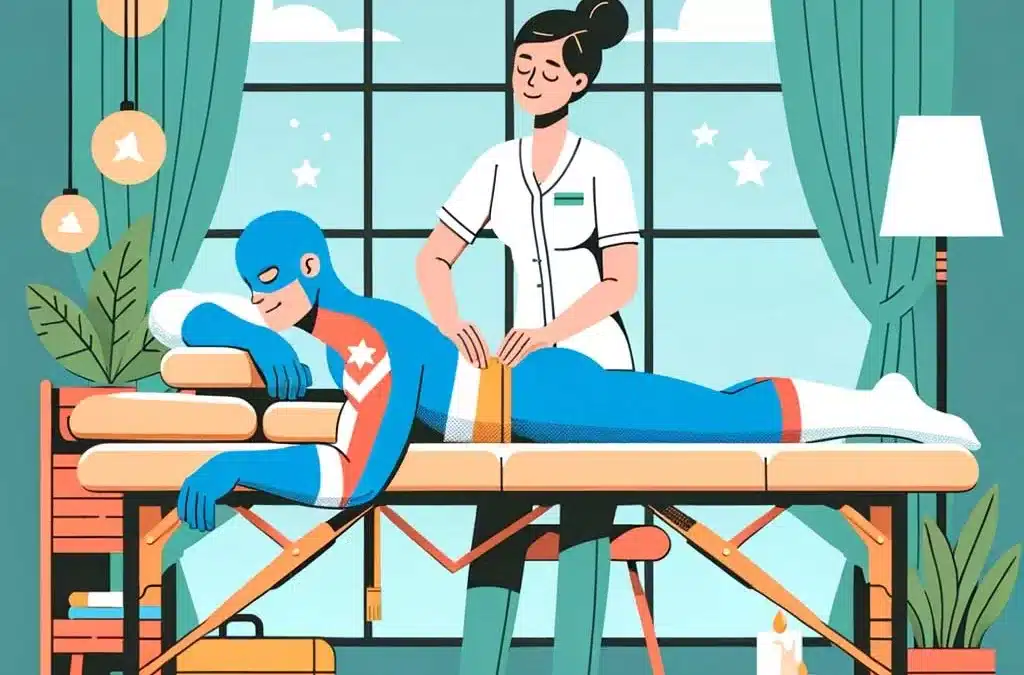
In an era where peak performance is not just desired but demanded, the benefits of massage therapy have emerged as a vital ally. Once seen as a luxury, it's now recognized as a necessity for anyone engaged in physically demanding activities. Superheroes, both in comics and in our daily lives, epitomize the peak of physical prowess. But even these extraordinary figures aren't immune to the rigors of their roles. Just like professional athletes and active individuals, superheroes need a strategy for recovery and maintenance. Massage therapy offers just that – a path to sustained health and readiness.
The Physical Demands of a Superhero
The life of a superhero is one of constant physical challenges. Leaping from buildings, battling villains, and saving the day are all in a day's work. These activities mirror the intense training and performances of high-level athletes. Just as an athlete needs to be in top condition, so does a superhero. The toll that such a lifestyle takes on the body is immense. It's not just about strength and agility; it's about the ability to recover and continue performing at the highest level. This is where the benefits of massage therapy come in.
Muscle Recovery and Cellular Health
Every action-packed day for a superhero involves muscle breakdown and repair. This cycle, similar to what athletes experience in their training, requires a focus on recovery to maintain peak performance. Massage therapy plays a critical role here. It doesn't just provide temporary relief but actively promotes muscle health. By reducing inflammation and knots in the muscles, massage ensures that these warriors are ready for their next battle. Clinical studies have shown that massage can significantly alleviate pain and enhance muscle recovery, making it an indispensable tool in a superhero's arsenal.
Enhanced Lymph Circulation and Injury Prevention
The unsung hero in our bodies, the lymphatic system, is crucial for removing waste products and aiding in recovery. Unlike the circulatory system, it doesn't have a pump. One of the big benefits of massage therapy is it assists in moving lymph fluid, facilitating quicker muscle recovery. For a superhero, this means less downtime and more action. By maintaining this balance, massage not only aids in recovery but also plays a preventative role, reducing the risk of injuries that can come from overuse or muscle imbalances.
Improving Flexibility and Range of Motion
The dynamic and often acrobatic movements of superheroes require exceptional flexibility and range of motion. Regular massage therapy can significantly improve these aspects. It works by loosening tight muscles and allowing for a greater degree of movement. This flexibility is not just about impressive feats of agility; it's a crucial element in avoiding injuries and maintaining the fluid, graceful movements that define a superhero's combat style.
Boosted Stamina and Endurance
In the world of superheroes, stamina and endurance are as important as any superpower. The benefits of massage therapy are unsung heroes in this regard. By enhancing blood circulation and facilitating the efficient removal of metabolic wastes, it helps boost stamina. This ensures that superheroes can endure prolonged battles and demanding rescue missions without faltering. Enhanced muscle tone, a byproduct of regular massages, also contributes to this increased endurance, allowing our heroes to stay resilient in the face of unending challenges.
Mental Recovery: Confidence and Clarity
The benefits of massage therapy extend beyond the physical. The mental fortitude required to face villainous threats and high-stress situations is immense. Massage therapy aids in this mental preparation by promoting relaxation, reducing anxiety, and improving overall mood. It supports better sleep, heightened positivity, and sharper mental alertness. For a superhero, this translates to improved decision-making and confidence in the heat of battle, ensuring that their mind is as prepared as their body.
The Aesthetic Benefits: Nourishing Skin and Hair
Often overlooked, the aesthetic benefits of massage therapy are also noteworthy. Increased blood flow during a massage session doesn't just help with muscle recovery; it also nourishes the skin and hair. For superheroes, whose appearance can be a part of their persona and public image, maintaining a healthy appearance is not just about vanity but also about inspiring confidence and trust in those they protect. This aspect of massage therapy ensures that our heroes not only feel good but also look the part.
Conclusion
The life of a superhero, much like that of an athlete or a highly active individual, demands a rigorous focus on physical and mental well-being. Massage therapy emerges as a crucial component in this regimen. Its benefits, ranging from enhanced muscle recovery, improved flexibility, increased stamina, and mental clarity to aesthetic improvements, form the backbone of a superhero's readiness to face new challenges every day. Integrating regular massage into one's routine is not just about recovery; it's about maintaining a state of peak performance.
Are you ready to embrace the superhero within? At That’s The Rub, we offer a diverse range of therapeutic massage options tailored to your unique needs. Whether you're battling daily stress or preparing for your next big challenge, our expert therapists are here to help. Visit our menu to explore our services and book your session today. Discover the transformative power of massage and take the first step towards your own heroic journey of health and well-being.